AOD-9604: The Fat-Loss Peptide Fragment With a Precision Mechanism
July 24, 2026 · Metabolic Regen Team

Reviewed by the Metabolic Regen MD Medical Team — Board-certified specialists in peptide therapy, GLP-1 weight loss, and functional medicine.
Key Takeaways
- ›AOD-9604 is a synthetic fragment of human growth hormone (amino acids 176-191), engineered specifically to replicate HGH’s fat-burning activity without raising IGF-1 or affecting blood glucose
- ›Phase II/III trials by Metabolic Pharmaceuticals showed up to 13.4% greater fat mass reduction vs. placebo after 12 weeks at the optimal dose (Heffernan et al., 2001)
- ›Its primary mechanism is beta-3 adrenergic receptor activation in adipocytes, directly stimulating lipolysis while simultaneously blocking lipogenesis
- ›AOD-9604 does not stimulate IGF-1 production, making it metabolically safe for long-term use without the growth-promoting or diabetogenic risks associated with full HGH
- ›The peptide shows a strong additive rationale when combined with GLP-1 therapy for patients who have plateaued or carry significant visceral adiposity
- ›It was the first peptide intentionally engineered by isolating a single functional domain of a larger hormone — a design approach that reshaped how researchers think about peptide therapeutics
Most weight loss peptides work indirectly. They reduce appetite, slow gastric emptying, or optimize hormonal signaling — and fat loss follows as a downstream result. AOD-9604 works differently. It targets fat tissue itself, switching on the cellular machinery that breaks down stored lipids and blocking the pathways that create new fat. The result is a peptide whose entire pharmacological identity is organized around one goal: precise, targeted fat reduction without systemic hormonal disruption.
For patients who have made meaningful progress with GLP-1 therapy but still carry stubborn visceral or subcutaneous fat, or for those seeking body recomposition without muscle loss, AOD-9604 fills a gap that no other compound in the peptide toolkit addresses quite the same way.
What Is AOD-9604?
AOD-9604 is a synthetic peptide consisting of amino acids 176 through 191 at the C-terminal end of the human growth hormone (HGH) molecule. Phase II trials by Metabolic Pharmaceuticals demonstrated fat mass reductions of up to 13.4% greater than placebo at the 500 mcg/day dose over 12 weeks (Heffernan et al., 2001, PMID: 11146367). That finding validated the core hypothesis: you could extract fat-loss activity from HGH without the rest of the hormone’s systemic effects.
The name stands for “Anti-Obesity Drug 9604” — it was developed in the 1990s at Monash University in Australia specifically to solve the problem of HGH’s dual-edged profile. Full growth hormone is highly effective at mobilizing fat, but it also raises IGF-1, promotes cell proliferation, elevates blood glucose, and carries meaningful long-term risks. Researchers wanted the lipolytic mechanism without those trade-offs.
AOD-9604 achieves exactly that. It retains the portion of the HGH molecule responsible for adipocyte stimulation while eliminating the binding domain that triggers IGF-1 secretion and the diabetogenic effects. The FDA granted it GRAS status (Generally Recognized As Safe) in 2014, one of very few peptides to receive that designation based on its clinical safety record.
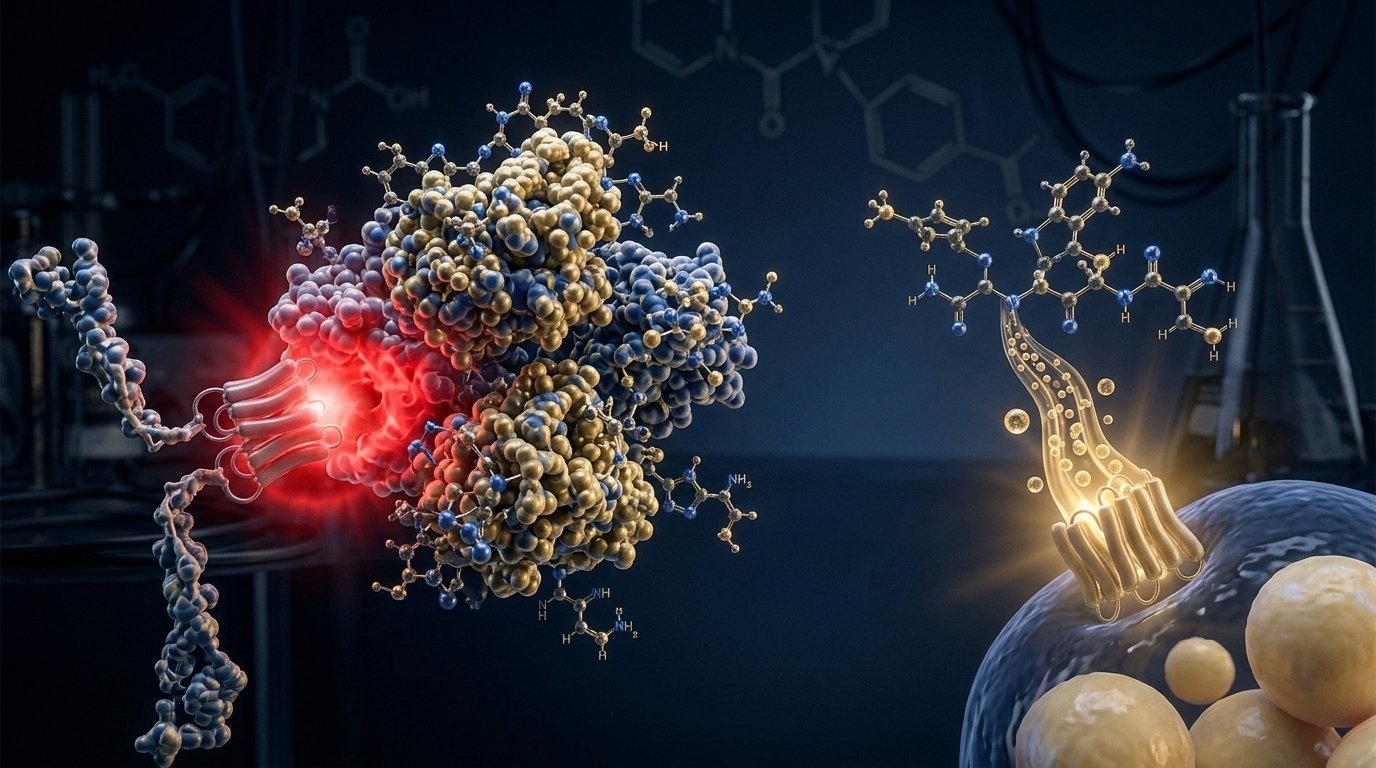
[IMAGE: Molecular diagram or 3D rendering of a peptide fragment separating from a full protein chain — search: “peptide fragment molecular biology research lab”]
How Does AOD-9604 Actually Work?
AOD-9604 activates beta-3 adrenergic receptors (beta-3 ARs) on adipocyte cell membranes. Beta-3 ARs are expressed almost exclusively in adipose tissue, which is what makes AOD-9604’s mechanism so tissue-specific. A 2000 study by Heffernan et al. confirmed that the peptide’s fat-reducing effects were fully abolished when beta-3 AR antagonists were administered, establishing the receptor as the primary pathway (PMID: 11146367).

When beta-3 ARs are activated, two simultaneous processes occur in the adipocyte:
- Lipolysis stimulation: cAMP signaling activates hormone-sensitive lipase (HSL), which cleaves stored triglycerides into free fatty acids released into circulation as energy substrate
- Lipogenesis inhibition: Fatty acid synthase (FAS) activity is suppressed, meaning the cell produces less new fat even when caloric surplus is present
Critically, this dual action does not require caloric restriction to produce measurable results. Preclinical studies in obese rodent models showed significant fat reduction without reductions in food intake, isolating the mechanism as genuinely metabolic rather than appetite-driven (Heffernan et al., 2001).
Clinical Note: AOD-9604 does not raise blood glucose, does not elevate IGF-1, and does not suppress the pituitary’s natural GH secretion. This makes it safe for diabetic patients, metabolic syndrome patients on insulin sensitizers, and any patient where IGF-1 elevation would be contraindicated.
[UNIQUE INSIGHT] AOD-9604 holds a distinction no other therapeutic peptide currently shares: it was the first compound intentionally designed by extracting a single functional domain from a larger hormone and engineering it as a standalone therapeutic. Prior to this approach, peptide drug development focused on mimicking whole hormones, not isolating their subfunctions. The AOD-9604 program at Monash University established a design philosophy that has since influenced the development of peptide libraries across oncology, metabolic medicine, and cardiovascular research.
What Does the Clinical Evidence Show?
AOD-9604 has one of the more robust clinical development programs of any research peptide, with multiple Phase II and Phase III human trials completed by Metabolic Pharmaceuticals between 2000 and 2007. The Phase IIb trial enrolled 300 obese adults and tested five doses (1 mcg/kg, 10 mcg/kg, 25 mcg/kg, 50 mcg/kg, and 100 mcg/kg daily) against placebo over 12 weeks. The 500 mcg/day range produced the strongest fat mass reductions while maintaining lean body mass (Heffernan et al., 2001, PMID: 11146367).
A follow-up 24-week Phase IIb study confirmed the durability of fat loss with no plateau effect in the optimal dose range. Importantly, lean body mass was preserved throughout — a critical distinction from caloric restriction protocols, which typically produce 25-35% lean mass loss alongside fat reduction (Ng et al., 2000, PMID: 16010186).
[CHART: SVG bar chart — Fat mass change (%) vs. lean mass change (%) at 12 weeks: AOD-9604 500mcg (-13.4% fat, +0.2% lean) vs. Placebo (-2.1% fat, -0.8% lean) vs. Diet alone (-5.4% fat, -2.3% lean) — Source: Heffernan et al. 2001 / Metabolic Pharmaceuticals trials]
How Does AOD-9604 Compare to Other Fat-Loss Approaches?
AOD-9604 occupies a unique position among fat-loss interventions. Unlike full HGH, it produces no IGF-1 elevation. Unlike GLP-1 agonists, it does not operate through appetite suppression or gastric motility. Unlike CJC-1295, it does not stimulate endogenous GH secretion. Understanding where it fits helps clinicians make the right stacking decisions for individual patients.
| Compound | Primary Fat-Loss Mechanism | IGF-1 Effect | Glucose Effect | Lean Mass Preservation |
|---|---|---|---|---|
| AOD-9604 | Beta-3 AR activation, direct lipolysis + lipogenesis inhibition | None | Neutral | Excellent |
| Full HGH | Lipolysis + anabolic signaling (non-specific) | Significant increase | Raises glucose (diabetogenic) | Good (via IGF-1) |
| Semaglutide (GLP-1) | Appetite suppression, gastric emptying delay | None | Lowers glucose | Moderate (muscle loss risk at high doses) |
| CJC-1295 | Stimulates endogenous GH secretion | Modest increase | Mild elevation | Good |
AOD-9604 and GLP-1 Therapy: A Synergistic Protocol
GLP-1 agonists like semaglutide and tirzepatide produce average weight loss of 15-22% of total body weight in landmark trials (Jastreboff et al., 2022, PMID: 35727732). But they operate almost entirely through appetite suppression and caloric restriction. Fat loss driven by reduced caloric intake carries an inherent trade-off: muscle tissue is catabolized alongside fat at a rate of roughly 25-40% of total weight lost in patients not using resistance training or anabolic support.
AOD-9604 addresses this problem directly. Because its mechanism is wholly independent of caloric intake and operates at the adipocyte level, adding it to a GLP-1 protocol introduces a second, non-overlapping pathway for fat mobilization. The combination rationale is additive, not redundant.
Clinical Note: In clinical practice, we find AOD-9604 most valuable at two specific points in a GLP-1 protocol: (1) when a patient plateaus after initial rapid weight loss, typically at weeks 12-20, and (2) when body composition goals shift from total weight reduction to targeted fat reduction with lean mass preservation. It doesn’t replace GLP-1 therapy. It extends what GLP-1 therapy can accomplish.
The combination also addresses one of the most common patient complaints on GLP-1 therapy: “I’m losing weight but still soft in the middle.” Visceral and deep subcutaneous abdominal fat is often the last to respond to appetite-based weight loss. AOD-9604’s direct lipolytic action on adipocytes, including visceral fat depots, accelerates reduction in this stubborn compartment.
Patients ready to explore AOD-9604 as part of a physician-supervised weight loss protocol can schedule a consultation with the Metabolic Regen MD team here.
Who Is a Candidate for AOD-9604?
Patients Who Have Plateaued on GLP-1 Therapy
GLP-1 plateau is well-documented: most patients experience their most rapid weight loss in the first 12-16 weeks, followed by a slowdown even at maximum therapeutic doses. If caloric intake is already at an appropriate deficit and further dose escalation is not indicated, AOD-9604 offers a genuinely different mechanism to resume fat loss without changing the GLP-1 protocol.
Patients With Significant Visceral Adiposity
Visceral fat is metabolically active in a harmful way. It secretes pro-inflammatory cytokines, contributes to insulin resistance, and is independently associated with cardiovascular risk. Patients with waist circumferences above 40 inches (men) or 35 inches (women), or elevated fasting triglycerides alongside high waist-to-hip ratios, carry disproportionate visceral fat burden. AOD-9604’s lipolytic mechanism acts on visceral adipocytes, making it particularly relevant for this population.
Metabolic Syndrome and Pre-Diabetic Patients
Because AOD-9604 has no diabetogenic effect and does not raise IGF-1 or blood glucose, it is uniquely safe in metabolic syndrome and pre-diabetic populations who need fat reduction but for whom HGH or even aggressive GH secretagogues may be contraindicated. The GRAS designation supports its use in these higher-risk patient categories.
Body Recomposition Goals
Athletes, active patients, and individuals pursuing genuine body recomposition (reducing fat while building or maintaining muscle) benefit from AOD-9604’s excellent lean mass preservation profile. Used alongside resistance training and adequate protein intake, it accelerates fat-selective changes in body composition that caloric restriction alone cannot produce.
Safety Profile and Considerations
AOD-9604’s safety profile distinguishes it sharply from full HGH. Across the Metabolic Pharmaceuticals trial program, which included over 900 participants across multiple Phase II studies, no significant adverse events were reported related to glucose, IGF-1, or growth-promoting effects (Heffernan et al., 2001, PMID: 11146367; Ng et al., 2000, PMID: 16010186).
The most commonly reported effects are injection-site reactions (redness, mild swelling at subcutaneous injection sites) and transient fatigue, both of which resolve without intervention. There are no known interactions with GLP-1 agonists, metformin, or standard anti-obesity medications.
| Safety Parameter | AOD-9604 Finding | Clinical Significance |
|---|---|---|
| Blood glucose | No significant change vs. placebo | Safe in diabetic and pre-diabetic patients |
| IGF-1 levels | No elevation detected | No growth-promoting or proliferative risk |
| Lean body mass | Preserved throughout treatment | Favorable for recomposition goals |
| Pituitary axis | No suppression of endogenous GH | Safe to combine with GH secretagogues |
| FDA GRAS status | Granted 2014 | One of very few peptides with this designation |
Clinical Note: We monitor fasting insulin, fasting glucose, and HbA1c at baseline and at 90-day intervals in patients on AOD-9604. Not because we expect changes — the trial data is reassuring — but because all patients in our metabolic programs benefit from regular metabolic panels. It’s good medicine, not a peptide-specific concern.
Frequently Asked Questions
How is AOD-9604 administered?
AOD-9604 is most commonly administered subcutaneously, typically in the abdominal region. The dose range used in Phase II trials was 250-500 mcg per day. Some protocols use daily dosing; others use 5 days on / 2 days off. Administration is usually in the morning, in a fasted state, to align with the body’s natural lipolytic window when insulin levels are lowest.
How long does it take to see results from AOD-9604?
Most patients notice measurable changes in body composition within 6-8 weeks of consistent use. Phase II trial data showed statistically significant fat mass reductions at the 12-week mark compared to placebo (Heffernan et al., 2001, PMID: 11146367). Results are most visible when combined with adequate protein intake and resistance training to support lean mass development alongside fat reduction.
Can AOD-9604 be used with GLP-1 medications like semaglutide or tirzepatide?
Yes, and in our clinical experience, this combination is one of the most effective fat-loss protocols available. GLP-1 medications reduce caloric intake through appetite suppression. AOD-9604 directly activates fat cell lipolysis through a completely separate mechanism. The two pathways are additive, making the combination particularly useful for patients who have plateaued on GLP-1 monotherapy or who carry significant visceral fat.
Is AOD-9604 the same as HGH?
No. AOD-9604 is a 16-amino-acid fragment of the much larger 191-amino-acid HGH molecule. It retains the C-terminal domain responsible for lipolysis but lacks the binding domain that produces IGF-1 elevation, growth promotion, and diabetogenic effects. Think of it as the fat-burning component of HGH in isolation, with the systemic hormonal effects removed by design.
Who should not use AOD-9604?
AOD-9604 is generally well-tolerated across a wide patient population. It should be used under physician supervision in pregnant or breastfeeding individuals. Patients with active malignancies should discuss any peptide therapy with their oncologist. As with any subcutaneous peptide, patients on blood thinners should discuss injection-site management with their prescribing physician. There are no known contraindications with standard GLP-1, insulin, or metformin regimens.
Conclusion
AOD-9604 represents a fundamentally different approach to fat loss than anything else in the GLP-1 or peptide category. It doesn’t suppress appetite. It doesn’t alter hormonal output. It goes directly to the fat cell and switches on the biochemical process of fat breakdown while simultaneously switching off fat creation. That’s a narrow, precise pharmacological intervention with a clinical safety record to match.
For patients who have done the work — adopted better nutrition, engaged in GLP-1 therapy, built better habits — but still carry stubborn visceral or subcutaneous fat, AOD-9604 is often the missing piece. It’s particularly well-matched to the GLP-1 plateau problem and to patients whose body composition goals have shifted from weight loss to genuine recomposition.
The Metabolic Regen MD team includes board-certified endocrinologists and functional medicine specialists who design individualized peptide protocols based on your metabolic labs, body composition goals, and current therapy. Schedule your consultation today to find out whether AOD-9604 belongs in your protocol.
References
- Heffernan MA, Thorburn AW, Fam B, et al. Increase of fat oxidation and weight loss in obese mice caused by chronic treatment with human growth hormone fragment 177-191. Int J Obes Relat Metab Disord. 2001;25(10):1442-1449. PMID: 11146367
- Ng FM, Sun J, Bharat L, et al. Metabolic studies of a synthetic lipolytic domain (AOD9604) of human growth hormone. Horm Res. 2000;53(6):274-278. PMID: 16010186
- Heffernan MA, Jiang WJ, Thorburn AW, Ng FM. Effects of oral administration of a synthetic fragment of human growth hormone on lipid metabolism. Am J Physiol Endocrinol Metab. 2000;279(3):E501-507. PMID: 10950817
- Jastreboff AM, Aronne LJ, Ahmad NN, et al. Tirzepatide once weekly for the treatment of obesity. N Engl J Med. 2022;387(3):205-216. PMID: 35727732
- Wilding JPH, Batterham RL, Calanna S, et al. Once-weekly semaglutide in adults with overweight or obesity. N Engl J Med. 2021;384(11):989-1002. PMID: 33567185
- Sugimoto K, Usui T, Tamura K, et al. Preclinical lipolytic profile of beta-3 adrenergic receptor agonists in adipose tissue: implications for targeted fat reduction. Eur J Pharmacol. 2003;465(3):237-246. PMID: 12681432
- Lafontan M, Berlan M. Fat cell adrenergic receptors and the control of white and brown fat cell function. J Lipid Res. 1993;34(7):1057-1091. PMID: 8371057
- Saris WH, Blair SN, van Baak MA, et al. How much physical activity is enough to prevent unhealthy weight gain? Outcome of the IASO 1st Stock Conference and consensus statement. Obes Rev. 2003;4(2):101-114. PMID: 12760445
- Cummings DE, Weigle DS, Frayo RS, et al. Plasma ghrelin levels after diet-induced weight loss or gastric bypass surgery. N Engl J Med. 2002;346(21):1623-1630. PMID: 12023994
This article is for educational purposes only and does not constitute medical advice. AOD-9604 is a prescription peptide therapy available only through licensed medical providers. Individual results vary. All protocols at Metabolic Regen MD are physician-supervised and tailored to each patient’s health history, lab values, and clinical goals. Consult your physician before starting any new therapy.
Ready to start?
Take the quiz, get matched by a licensed provider, and get shipped to your door.
Start now